
Autism Is Increasing, and Diagnostic Criteria Alone Cannot Explain It
Autism is increasing, and it is not because of expanding diagnostic criteria alone, as many purport. The broadening of the diagnostic definition over the past several decades is real, and it accounts for part of the rise in reported prevalence. But it does not account for all of it, and in my clinical experience it does not come close to explaining what I am seeing at the most affected end of the spectrum.
I have evaluated children across the autism spectrum in New York City since 2010, and the change I have seen is not subtle. It is also not mainly at the mild end. Year after year, more of the children referred to me are profoundly affected: nonspeaking or minimally verbal, requiring constant support, unable to complete standardized testing without significant accommodation. These are Level 3 presentations, the most severely disabled end of the spectrum, and there are far more of them than there were fifteen years ago.
The standard explanation for rising autism numbers is that we have widened the definition and are simply catching milder cases that were always there. Whatever truth that holds for the mild end, it does not explain what I am seeing. The increase in my practice is driven by children at the severe end of the spectrum, those with significant cognitive and communication impairment, and their numbers have grown markedly over the past decade.
The scale of the increase is visible in the state's own numbers. Across New York City, the count of students classified with autism has more than tripled in a little over a decade, from about 12,000 in 2011-12 to more than 40,000 today. The climb has been steady and it has accelerated.
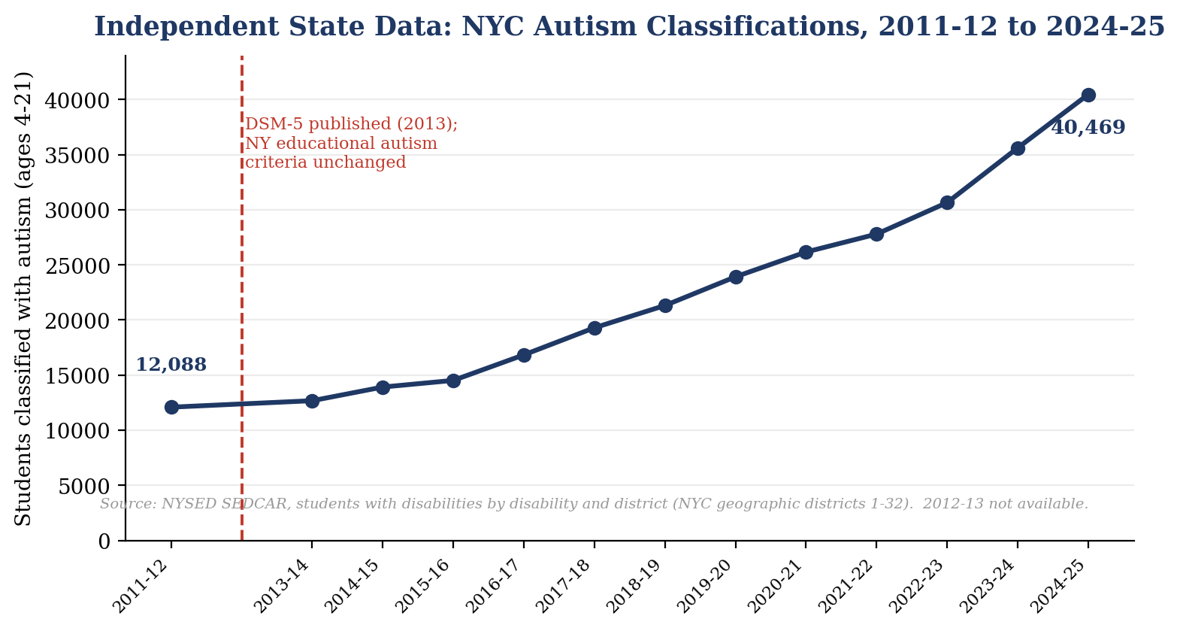
New York City students classified with autism, 2011-12 to 2024-25. Source: New York State education data.
You do not have to take my word for what this means on the ground, because the systems built for the most significantly disabled are visibly straining to keep up. In my own field I have watched a wave of new private schools open to serve severely affected autistic children, existing programs expand, and established schools add satellite locations to meet demand that did not exist a decade ago. Private and nonpublic school enrollment is not tracked in any public dataset, so that expansion cannot be counted directly. But the public system can be. District 75, the New York City public district that serves students with the most significant disabilities, has been expanding its enrollment and opening new sites across the city. These are not programs for mild cases. They exist for children who need the most support, and they are growing.
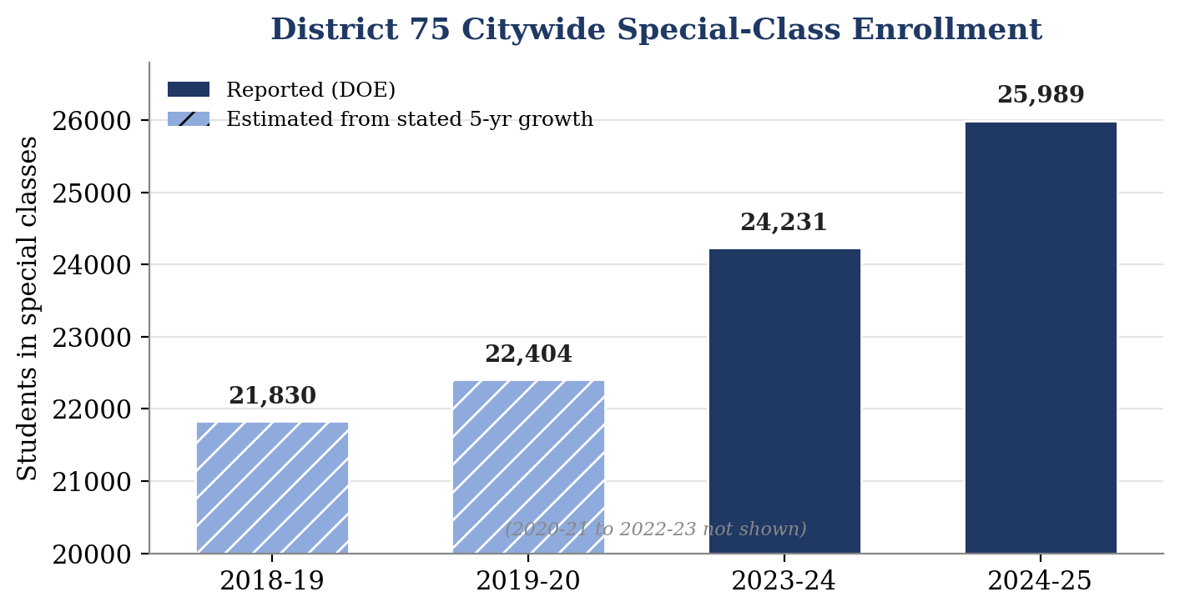
District 75 special-class enrollment. Recent years are reported by the DOE; the two earliest bars are estimated from stated growth rates.
The same is true in the system that supports people for a lifetime. New York's Office for People With Developmental Disabilities serves those whose disabilities are severe enough to require lifelong support, precisely the population a broadened diagnosis does not add. New York's own Autism Cost Study reports that within OPWDD, people with an autism diagnosis are the fastest growing population in both raw numbers and percentages, even as they remain a minority of those served. The count bears that out: from the study's figures and OPWDD's subsequent reports, the number of people served with autism rose from about 20,800 in 2015 to more than 39,000 in 2024, nearly doubling. Autism is not the largest category in the system, but by my calculation from OPWDD's published figures it accounts for roughly nine in ten of the system's net growth in recent years. It is the diagnosis driving the increase.
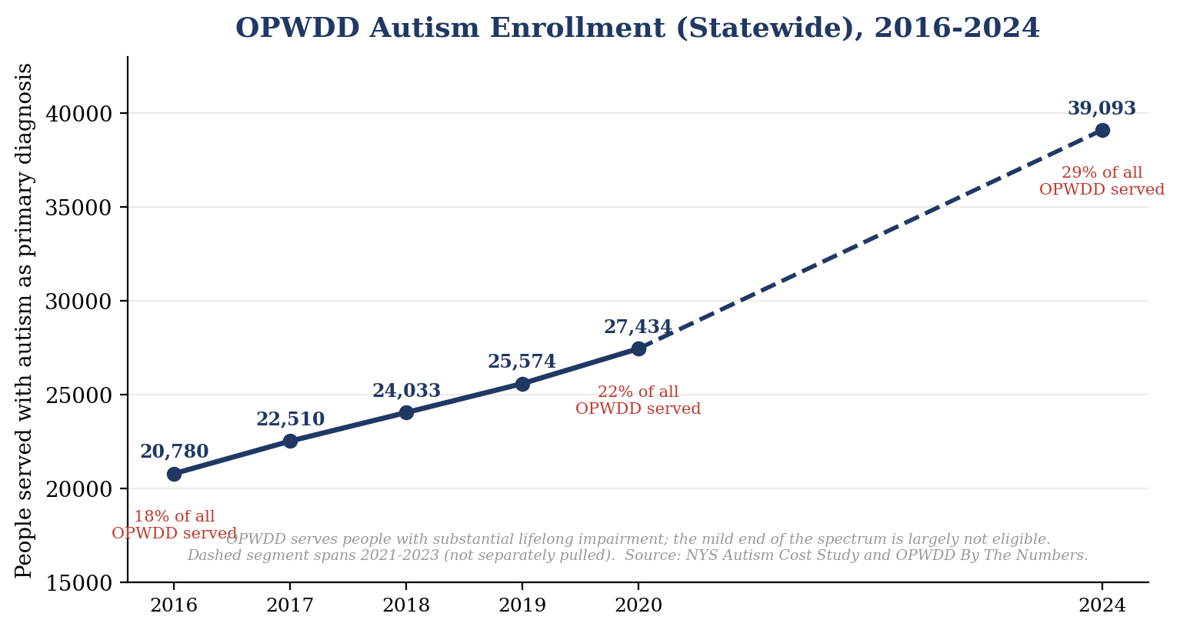
People served by OPWDD with autism as a primary diagnosis, statewide. OPWDD serves people with substantial, lifelong impairment.
Put the pieces together and the picture is hard to miss. The number of severely disabled children is climbing, and autism is the force behind the climb. In my office, in the schools built for the most affected students, and in the system that supports the most impaired adults, the same trend appears. This is not a wider net catching milder cases. It is more children who are seriously, visibly, and permanently disabled, and increasingly those children have autism.
To tell the families of these children that nothing has really changed, that we are only counting better, is a form of gaslighting. It asks these families to distrust their own eyes, and it looks past the children with the greatest needs and the least ability to speak for themselves. The complacency also has a price. If the rise is presumed to be an illusion of definitions, then there is nothing to explain, nothing to investigate, and no reason to look for a cause. The more honest and more useful posture is to accept that the number of severely disabled children is rising, that autism is driving it, and to ask, without foreclosing any serious line of inquiry, “why?”.
Source: New York State Autism Cost Study Report (2022), prepared pursuant to Chapter 210 of the Laws of 2018, New York State Office for People With Developmental Disabilities. OPWDD enrollment figures for 2024 are drawn from OPWDD By The Numbers (2024 data). District 75 and citywide classification figures are from New York City Department of Education and New York State Education Department special education data.